
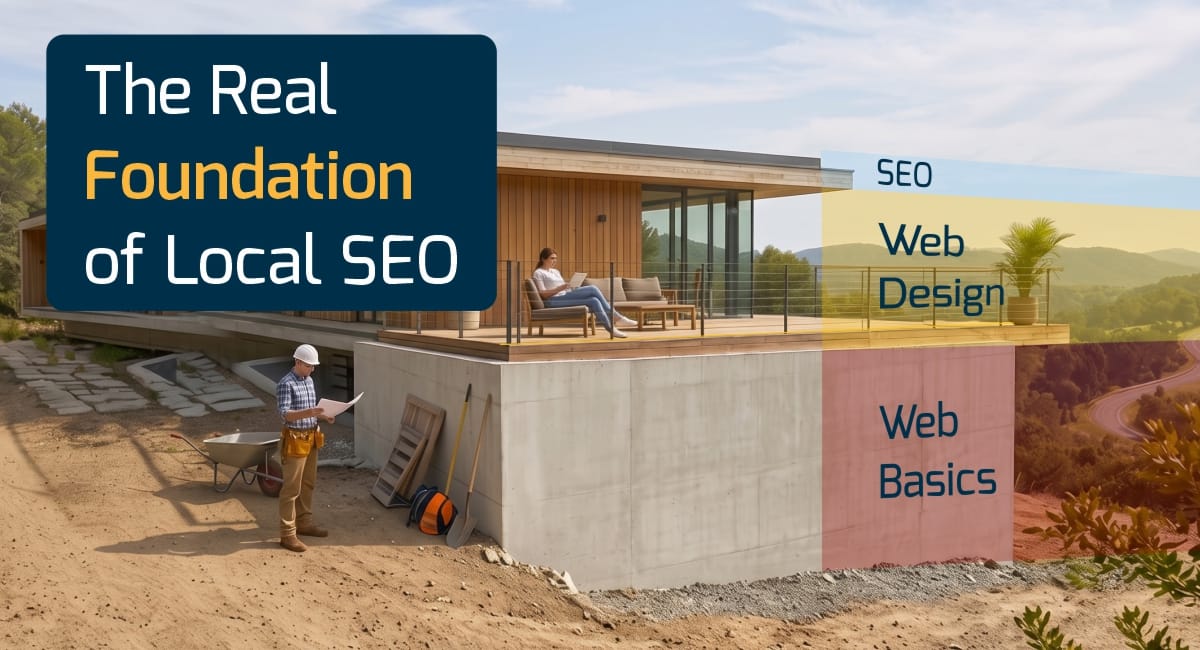
I get asked some version of this question a lot: "Can you do SEO for my site?" And my honest answer usually surprises people: a lot of what gets sold as SEO is really a design and development problem. How fast your site loads, how it responds to taps, how stable the layout stays, and whether the mobile version works all affect how Google sees you, and none of that is fixed with a keyword strategy. Here’s why a well-built website is the foundation local SEO sits on.
I’m not saying SEO strategy doesn’t matter. Content, keywords, and local relevance absolutely count. But before any of that has a chance to work, your site has to be built in a way that Google (and your actual visitors) can use without friction. That part isn't a marketing add-on. It's the foundation everything else sits on.
Speed and Stability Aren't "Technical Stuff," They're Ranking Signals
Google now measures three specific things about how a page behaves for real visitors: how fast the main content loads, how quickly the page responds when someone taps or clicks something, and how much the layout jumps around while it's loading. These are called Core Web Vitals, and Google uses them as ranking signals. They’re not the only thing that matters, but a slow, unstable site starts at a disadvantage.
Here’s the part that matters for this conversation: all three of those are shaped largely by how a site is designed and built. A bloated template loaded with unnecessary scripts, oversized images, and a cheap hosting plan can fail these metrics no matter how well-written the content is. That’s not an SEO problem you fix with a keyword strategy. It’s a build problem.
| What Google Measures | What Actually Controls It |
|---|---|
| How fast the page loads | Image sizes, code efficiency, hosting quality |
| How quickly the page responds to taps or clicks | Clean, lightweight code |
| How stable the layout stays while loading | Proper design and layout planning |
Not sure how your site is actually performing on these metrics? Get in touch and I'll take a real look, no obligation.
Mobile Isn't a Version of Your Site Anymore, It's the Main Event
Here's something a lot of business owners don't realize: Google evaluates the mobile version of your site as the primary version, not the desktop one. If your site was originally designed desktop-first and mobile was an afterthought, that's not a small cosmetic issue anymore. It's the version search engines are actually judging you on.
I saw this play out directly on a recent redesign for a Pinellas County pet care business (you can read the full story in A Real WordPress Redesign Story, or see the pet care case study). The old site wasn’t mobile-friendly at all, which meant Google was effectively evaluating a broken experience. Once I rebuilt it to be fully responsive, that piece of the SEO puzzle solved itself, without a single SEO-specific task on the invoice.

Most site owners think of mobile-friendliness as a nice bonus. Google thinks of it as the main test.
Structure and Navigation Aren't Just About Looking Organized
A clean heading structure (a real H1, followed by logical H2s and H3s), sensible navigation, and a site that's easy for both people and search engines to move through isn't a design nicety. It's literally how Google figures out what your page is about and how your pages relate to each other. A confusing, disorganized site makes that job harder for Google, the same way it makes life harder for an actual visitor trying to find your contact page.
This is also where I come back to the pivot I made in how I talk about my own work: I don't pitch SEO as a separate product. When I build or rebuild a site, I build it with proper structure, clean code, real mobile responsiveness, and sensible navigation from the start. SEO improvement isn't something I bolt on afterward. It's what happens naturally when the underlying site isn't fighting against itself.
What This Means If You're Shopping for "SEO Help"
If someone offers to "do SEO" for your business without ever looking at how the site itself is built, ask what exactly they're optimizing. Keywords and content matter, but they're working against a ceiling if the site underneath is slow, not mobile-friendly, or structurally confusing. I’d rather tell a prospective client that their real problem is the build, not something another monthly SEO retainer will fix, even if that’s a less exciting sales pitch.
The Honest Bottom Line
Good SEO doesn't start with a keyword list. It starts with a site that's fast, mobile-friendly, and built with real structure, the same fundamentals that make a site good for actual visitors in the first place. When I build or rebuild a website, I'm not selling you SEO as a separate line item. I'm building something that doesn't need to apologize for itself once it goes live.
I build and rebuild websites for businesses across Tampa Bay, including St. Petersburg and Clearwater.

About The Author
Hector Morales
Hector, Founder & Lead Designer of Online Survival, brings over 20 years of experience in web design, WordPress development, graphic design, and digital strategy. He helps businesses create custom websites built around clarity, performance, and long-term growth.
Frequently Asked Questions About Website Design and Local SEO
Does website design actually affect my Google ranking?
Yes. Google’s Core Web Vitals, which measure loading speed, responsiveness, and layout stability, are part of how Google evaluates pages, and all three are shaped largely by how a site is designed and built.
Is mobile-friendliness really that important for SEO?
Yes. Google evaluates the mobile version of your site as the primary version, so a poor mobile experience can hurt your rankings on desktop as well. A fully responsive build, with readable text, tap-friendly buttons, and fast-loading pages, is one of the most direct things you can do for local SEO.
If I hire someone just for SEO, will that fix a slow or poorly built site?
Not at first. Every site I build includes the technical SEO foundation: clean code, speed, a mobile-friendly layout, and clear structure. Ongoing work like content and local listings is a separate, optional service, and it works much better once the foundation is solid.
Do I need to buy SEO as a separate service from web design?
Not on its own. Keyword and content work can only do so much if the underlying site is slow, not mobile-friendly, or structurally confusing. Those are design and development issues, not something a content strategy alone can fix.
How do I know if my current site has these issues?
A real look at your site’s speed, mobile experience, and structure will usually tell you quickly. If you’re not sure, book a quick call and I’ll take a look before you spend money on a separate SEO service.